Summary: The contact center software market is projected to reach $77.82 billion in 2026, driven by AI, cloud adoption, and omnichannel demand across US businesses.
When customer expectations rise faster than your team can scale, the right technology becomes the deciding factor. Gartner predicts conversational AI will reduce contact center agent labor costs by $80 billion in 2026, a signal that the entire industry is undergoing a structural shift. For businesses across the United States, choosing from contact center software companies is no longer a matter of convenience; it is a strategic imperative that directly influences revenue, retention, and operational resilience. If you are evaluating platforms, our guide to call center software companies offers additional perspective on how providers compare.
The stakes are high, and the choices are numerous. From cloud-native upstarts to legacy vendors retrofitting AI capabilities, each platform brings a different architecture, pricing model, and deployment philosophy to the table. This article examines the forces reshaping the market, outlines the criteria that matter most, and provides a practical comparison of the platforms US organizations should evaluate in 2026.
Why the Contact Center Software Market Is Accelerating in 2026

The global contact center software market is projected to grow from $77.82 billion in 2026 to $263.75 billion by 2034, exhibiting a CAGR of 16.50%, according to Fortune Business Insights. This trajectory reflects a market that has moved well beyond incremental upgrades.
This strong growth stems from enterprises pivoting away from rigid voice-centric telephony toward cloud-native, generative-AI-orchestrated engagement platforms that collapse call-handling time and sharpen customer-experience metrics. The shift is especially pronounced in the United States, where the US market alone is projected to reach $14.15 billion by 2026.
Small and mid-sized enterprises are adopting at the fastest clip, exploiting pay-per-seat pricing to access features once restricted to multimillion-dollar on-premise suites. For healthcare practices, legal firms, and financial services teams, this means enterprise-grade capabilities are now within reach without a six-figure capital investment.
Key Criteria for Evaluating Contact Center Platforms
Not every platform suits every organization. Before comparing vendors, it is essential to establish a clear evaluation framework. The following criteria separate platforms that deliver lasting value from those that create new technical debt.
Cloud-native architecture is the foundation. Cloud deployments have become the default choice, with enterprises favoring consumption-based CCaaS subscriptions that trim deployment cycles to weeks and eliminate capital expenditure. A platform that still requires on-premise hardware or lengthy professional services engagements introduces unnecessary friction.
AI and automation depth matters beyond the marketing language. Look for platforms offering real-time agent assistance, automated quality management, and intelligent routing that improves with every interaction. According to Deloitte, 81% of contact center executives are investing in AI for agent-enabling technologies, as reported by SNS Insider.
Omnichannel integration ensures that voice, chat, email, SMS, and social channels share a unified interaction history. By 2026, omnichannel solutions are projected to account for 45% of the CCaaS market, according to Market.us. Platforms that treat channels as silos force agents to reconstruct context manually, which degrades both efficiency and customer satisfaction.
Security and compliance are non-negotiable, particularly for organizations in healthcare, finance, and legal services. Verify SOC 2 Type II, HIPAA, and PCI DSS certifications before proceeding with any vendor evaluation. Healthcare led with a 17.79% CAGR outlook between 2026 and 2031, reflecting the rapid uptake of HIPAA-compliant voice biometrics and real-time translation features, according to Mordor Intelligence.
Total cost of ownership extends beyond per-seat pricing. Factor in implementation timelines, integration costs, training, and ongoing maintenance. Cloud-native platforms with unified architectures tend to deliver lower total cost of ownership over a three-to-five-year horizon, even when the per-seat price appears higher at first glance.
How Leading Platforms Compare for US Businesses
The following table provides a side-by-side view of platforms that US organizations frequently evaluate. Each platform is assessed on criteria that matter most to mid-market and enterprise teams managing high-volume customer interactions.
| Platform | Deployment | AI Capabilities | Omnichannel | Starting Price | Ideal For |
|---|---|---|---|---|---|
| Cloud Vision Technologies | Cloud-native | AI Voice Agent, real-time analytics | Voice, AI-assisted channels | $16.99/user/month | SMB to enterprise; healthcare, legal, sales |
| RingCentral RingCX | Cloud-native | Agentic AI, quality management | Voice, chat, email, SMS, social | $30/user/month | Large enterprises with unified comms needs |
| Five9 | Cloud | AI agent assist, predictive dialing | Voice, digital channels | Custom pricing | Voice-heavy operations with CRM integration |
| Genesys Cloud CX | Cloud | Native AI, journey management | Voice, digital, messaging | Custom pricing | Large enterprises needing workforce engagement |
| NICE CXone | Cloud | AI-integrated analytics | Voice, digital, workforce | Custom pricing | Large-scale operations with complex analytics |
| Talkdesk | Cloud-native | AI-first, multi-agent orchestration | Voice, digital, messaging | Custom pricing | Regulated verticals (healthcare, finance) |
We designed our platform to eliminate the complexity that often accompanies legacy solutions. With our cloud contact center software, businesses can deploy in days rather than months, with no hardware required and a 99.9% uptime guarantee.
The AI Advantage: Why Automation Is Reshaping the Landscape
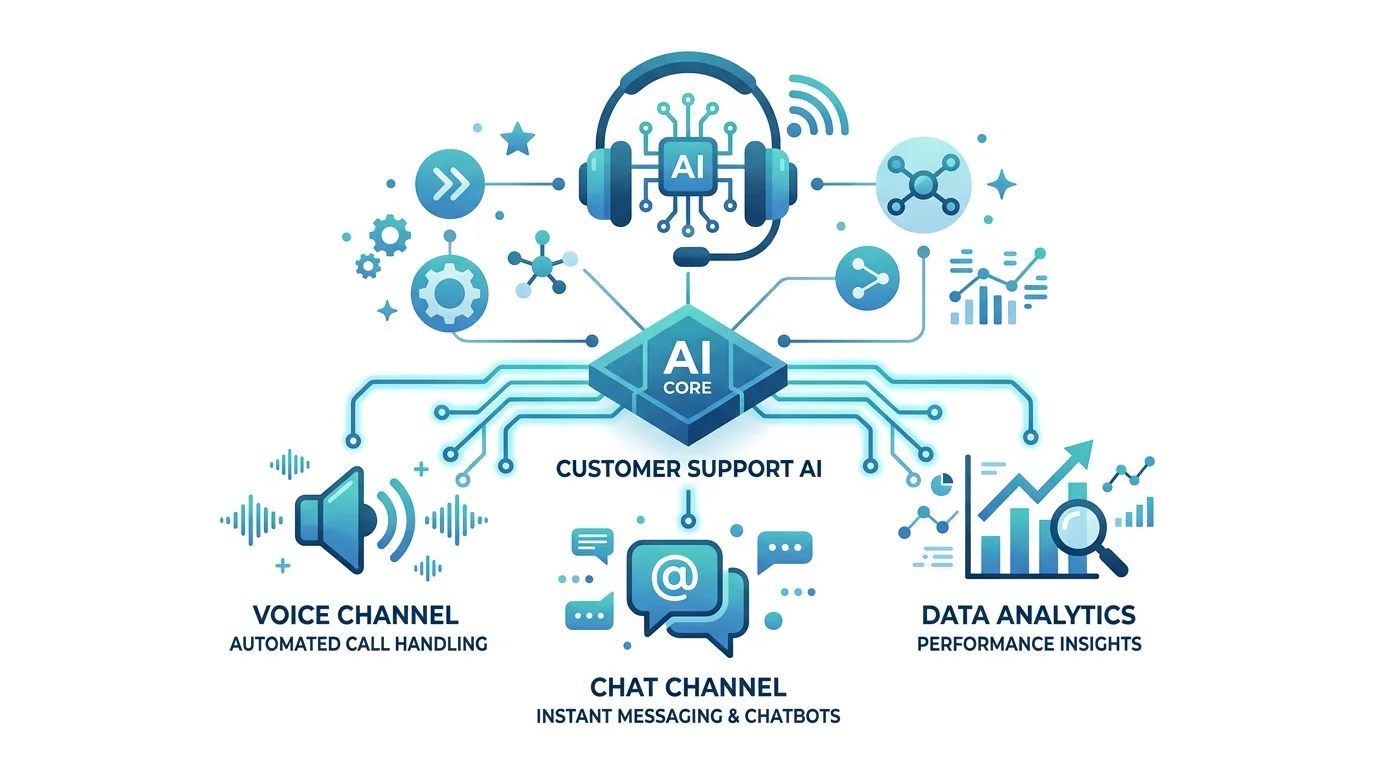
Voice AI costs roughly $0.40 per call compared to $7 to $12 for a human agent, according to CX Today data compiled by Ringly.io. This cost differential explains why artificial intelligence has moved from a feature differentiator to a baseline expectation.
AI in the contact center is not limited to chatbots and deflection. The most impactful implementations today span three categories. Conversational AI handles routine inquiries, schedules appointments, and processes FAQ responses without human intervention. Real-time agent assist surfaces recommended actions, compliance reminders, and customer sentiment during live conversations. Automated quality management scores every interaction rather than the industry-standard 1 to 2 percent sample.
Only 25% of call centers have fully integrated automation into daily operations, which means there is substantial headroom for organizations willing to invest. For businesses in healthcare, real estate, and professional services, AI Voice Agents can answer calls around the clock, ensuring that no patient inquiry or client question goes unanswered outside business hours.
Our AI Voice Agent is purpose-built for this scenario. It provides 24/7 coverage, schedules appointments automatically, and handles frequently asked questions, all while maintaining bank-grade encryption. If you are exploring providers, our overview of cloud contact center providers offers a deeper look at what to expect from cloud-first vendors.
Cloud Deployment: Speed, Flexibility, and Lower Total Cost
SMEs recorded the steepest growth trajectory, with a 19.32% CAGR through 2031, as pay-per-seat CCaaS licensing eliminated six-figure upfront costs. This statistic captures the central appeal of cloud-based contact center deployment: it levels the playing field.
Legacy on-premise systems typically require 6 to 12 months to deploy, with substantial professional services fees. Cloud-native platforms compress that timeline to days or weeks. Legacy integration complexity extends project timelines to two years and can introduce latency that degrades call quality, a risk that cloud-native architectures largely eliminate.
For US businesses scaling rapidly, whether adding seasonal agents in retail or onboarding new advisors in financial services, the ability to add seats without provisioning hardware is a meaningful operational advantage. We offer this exact capability with zero hardware costs and tiered pricing that starts at $16.99 per user per month.
Industry-Specific Considerations for US Organizations
The needs of a dental practice differ significantly from those of a national sales organization. While the core technology is shared, vertical requirements shape how a platform should be configured and evaluated.
Healthcare and dental practices require HIPAA-compliant call handling, appointment scheduling automation, and secure voicemail. Healthcare led with a 17.79% CAGR outlook between 2026 and 2031, making it one of the fastest-growing verticals for contact center adoption. Our inbound call center software supports these requirements with real-time dashboards and compliant call recording.
Legal and professional services teams need precise call routing, client intake automation, and detailed reporting for billing purposes. AI-driven intake can qualify callers before connecting them to the appropriate attorney or advisor, reducing non-billable time.
Sales organizations and real estate businesses benefit from outbound dialing capabilities, CRM integration, and performance analytics that tie call activity to revenue outcomes. Power dialers and campaign monitoring tools enable teams to maintain high activity levels without sacrificing call quality.
Financial services teams must balance compliance requirements (PCI DSS, SOX) with the need for responsive, personalized client interactions. Platforms that offer encrypted communications and role-based access controls address both needs simultaneously.
What to Avoid When Selecting a Platform
Decision fatigue often leads organizations to select platforms based on brand recognition alone. Several common pitfalls can result in costly misalignments.
- Overbuying features: A 500-agent enterprise platform is unnecessary for a 15-person sales team. Match the platform scope to your actual operational scale.
- Ignoring integration requirements: Verify that your CRM, ticketing system, and business intelligence tools connect natively. One of the major restraints of the contact center software market is the complexity and integration challenges associated with implementing new software solutions.
- Underestimating training timelines: A powerful platform that agents cannot use effectively yields no return. Prioritize intuitive interfaces and structured onboarding programs.
- Neglecting total cost of ownership: Per-seat pricing is only one component. Professional services, integration development, and ongoing maintenance can double the effective cost of some platforms.
Building a Future-Ready Contact Center Strategy
The pace of change in this market rewards organizations that plan for adaptability rather than locking into rigid architectures. Emerging technologies, such as artificial intelligence, cloud, predictive analysis, and machine learning, are projected to enhance contact center software capabilities. Platforms that embed these technologies natively, rather than bolting them on through third-party integrations, will deliver compounding value over time.
A practical approach involves starting with your highest-impact use case (often inbound call management or after-hours coverage), deploying quickly, and expanding based on measurable results. This phased strategy minimizes risk while accelerating return on investment.
For US businesses seeking a platform that combines cloud contact center technology, AI-driven automation, and enterprise-grade security at a price point accessible to SMBs and mid-market teams alike, the right partner makes all the difference. We deliver three integrated products (Hosted VoIP, AI Voice Agent, and Cloud Contact Center Software) from a single provider, eliminating the vendor sprawl and integration headaches that drain IT budgets. To see how it works in practice, book a free demo of our best call center software and experience the difference firsthand.
Frequently Asked Questions
What should US businesses look for in contact center software in 2026?
Prioritize cloud-native architecture, embedded AI capabilities (not bolt-on add-ons), omnichannel support, and compliance certifications relevant to your industry. Total cost of ownership over three to five years matters more than monthly per-seat pricing alone.
How much does contact center software typically cost?
Pricing varies widely. Enterprise platforms from established vendors often require custom quotes and significant implementation investment. Cloud-native providers such as Cloud Vision Technologies start at $16.99 per user per month with no hardware costs, making enterprise-grade features accessible to smaller teams.
Can small businesses benefit from AI-powered contact center platforms?
Yes. AI Voice Agents handle after-hours calls, schedule appointments, and answer common questions automatically, which is especially valuable for small healthcare practices, legal firms, and sales teams that cannot afford 24/7 staffing. Cloud-based, pay-per-seat models eliminate the upfront capital that historically restricted these tools to large organizations.