Summary: The best call center software in 2026 combines AI, omnichannel routing, and cloud deployment in a market projected to reach $77.82 billion globally this year.
When a single missed call can cost a deal or erode customer loyalty, the technology behind your phone lines matters more than ever. The global contact center software market is projected to grow from $77.82 billion in 2026 to $263.75 billion by 2034, exhibiting a CAGR of 16.50%, according to Fortune Business Insights. For US businesses of every size, choosing the best call center software is no longer a back-office decision; it is a strategic imperative that shapes revenue, retention, and brand reputation. Our cloud contact center software was built precisely for this moment.
Below, you will find an in-depth look at the features, deployment models, and evaluation criteria that separate exceptional platforms from average ones. Whether you manage a healthcare practice, a legal firm, or a high-volume sales floor, this guide will help you identify the solution that aligns with your goals, your budget, and the expectations of today’s customers.
Why Call Center Software Is a Strategic Priority in 2026

The call center landscape is undergoing a structural shift driven by artificial intelligence, cloud migration, and rising consumer expectations. The US market is expected to witness high growth due to increased integration and innovation in technologies such as cloud computing, Big Data analytics, and AI. The US market alone is projected to reach $14.15 billion by 2026.
Several converging forces explain this acceleration. Gartner predicts conversational AI will reduce contact center agent labor costs by $80 billion in 2026. At the same time, annual employee turnover in call centers ranges from 30% to 45%, with some centers experiencing rates as high as 60%, according to industry data compiled by Ringly.io. The right software mitigates both cost pressures: automation handles repetitive inquiries, while workforce tools reduce the burnout that drives attrition.
For organizations in healthcare, legal services, financial advisory, and retail, cloud-hosted call center solutions eliminate the need for on-premise hardware, speed up deployment, and adapt to fluctuating call volumes without capital expenditure. These advantages are especially relevant across the American market, where distributed and hybrid workforces have become the norm.
Core Features to Evaluate in Any Call Center Platform
Not every platform delivers the same depth of functionality. When comparing options, focus on the features that directly influence call resolution speed, agent productivity, and customer satisfaction.
Interactive Voice Response and Intelligent Routing
IVR systems allow callers to self-serve through menu options, reducing the volume of calls that require a live agent. The most advanced platforms pair IVR with automatic call distribution (ACD) and skills-based routing, directing each caller to the agent whose expertise matches the inquiry. This reduces transfers, shortens handle times, and improves first-contact resolution rates.
Omnichannel Communication
Customers expect to reach your team via voice, SMS, email, chat, or social messaging, and to pick up where they left off regardless of channel. Omnichannel routing synchronizes interaction history so agents never ask a caller to repeat information. The omnichannel call center solutions market was valued at about $24.5 billion in 2024 and is projected to grow to approximately $45.8 billion by 2032, a clear sign that multi-channel support is now table stakes.
Real-Time Analytics and Reporting
Dashboards that surface live call volume, queue wait times, and agent performance allow supervisors to make data-driven staffing decisions in the moment. Historical reports reveal trends that inform long-term strategy, from peak-hour patterns to recurring customer issues.
Call Recording and Quality Assurance
Recording every interaction, whether automatically or on demand, supports compliance, training, and dispute resolution. AI-powered quality assurance tools can now review 100% of calls, flagging sentiment shifts and compliance risks without manual effort.
Workforce Engagement and Management
Scheduling optimization, real-time adherence monitoring, and gamification features keep agents engaged and aligned with service level targets. Given that turnover remains one of the industry’s largest cost drivers, these tools offer a measurable return on investment.
How AI Is Reshaping Call Center Operations
88% of contact centers report using some form of AI, but only 25% have fully integrated it into daily operations. The gap between adoption and integration represents both a challenge and an opportunity for organizations willing to go further.
Gartner projects that 10% of all agent interactions will be fully automated by 2026, up from just 1.6% previously. This five-fold increase is concentrated in tier-one support tasks: order status checks, appointment scheduling, FAQ responses, and basic account updates. On a per-call basis, voice AI costs about $0.40 compared to $7 to $12 for a human agent, which explains the urgency behind AI adoption, according to Giva’s 2026 statistics report.
For businesses that field a high volume of routine calls, pairing an AI receptionist with live agents creates a layered system: the AI handles straightforward requests around the clock, while human agents focus on complex or sensitive interactions that require empathy and judgment.
Cloud Versus On-Premise Deployment: Which Model Fits?
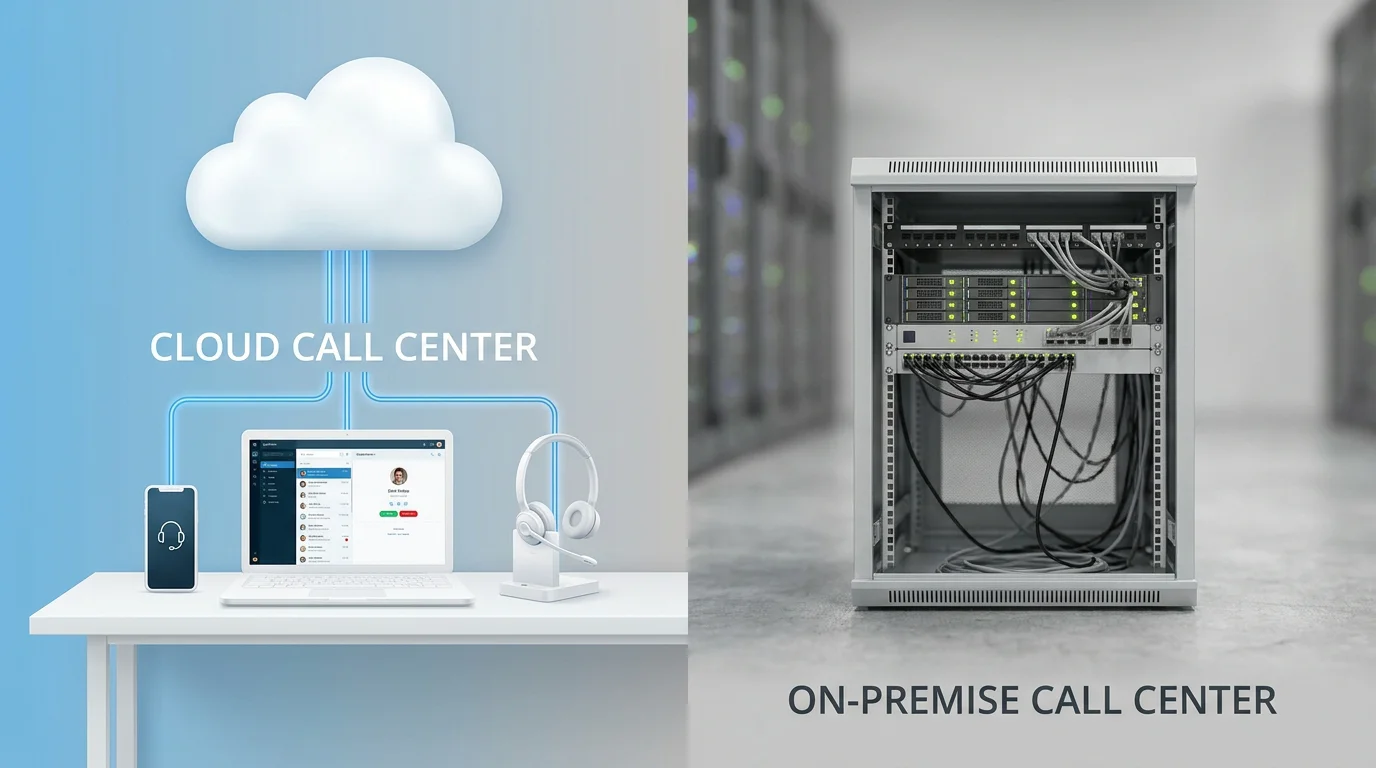
The cloud contact center software market has grown rapidly in recent years, from $19.78 billion in 2025 to an estimated $22.88 billion in 2026 at a CAGR of 15.7%, according to a Research and Markets report. This growth reflects a broad consensus: cloud deployment offers lower upfront costs, faster time to value, and the flexibility remote teams demand.
On-premise solutions still serve organizations with strict data sovereignty requirements, such as certain government agencies or highly regulated financial institutions. However, for the vast majority of small, midmarket, and enterprise businesses in the US, cloud-based contact center software delivers a better balance of security, scalability, and cost efficiency. Leading cloud platforms now offer bank-grade encryption, 99.9% uptime guarantees, and compliance certifications that satisfy even the most demanding regulatory frameworks.
Comparing Leading Call Center Software Solutions
The table below highlights key attributes of several well-known platforms alongside our own offering. Pricing, channel support, and deployment model are among the most important differentiators for buyers evaluating their options.
| Platform | Starting Price | Deployment | Key Strength | Free Trial |
|---|---|---|---|---|
| Cloud Vision Technologies | $16.99/user/month | Cloud | Integrated VoIP, AI Voice Agent, and contact center from one provider; no hardware required | Free demo |
| Nextiva | $75/agent/month | Cloud | Built-in CRM and workflow builder | No |
| Five9 | $119/month | Cloud | Workforce management and IVA tools | No |
| RingCentral | $20/user/month | Cloud | Unified communications integration | 14 days |
| Dialpad | $15/month | Cloud | AI transcription and coaching | 14 days |
| Zendesk | $19/agent/month | Cloud | Ticketing and knowledge management | 14 days |
While several platforms on this list provide solid capabilities, most require you to assemble multiple vendors or pay significantly more per seat to access AI, VoIP, and contact center features together. Our integrated approach bundles hosted VoIP, an intelligent voice AI agent, and full contact center platforms from a single provider, starting at just $16.99 per user per month with zero hardware costs.
What to Prioritize for Healthcare, Legal, and Sales Teams
Different industries place different demands on call center technology. A dental practice managing appointment confirmations has very different needs from an outbound sales floor running predictive dialer campaigns. Here is how to think about feature priorities by vertical.
Healthcare and Medical Practices
HIPAA compliance, secure call recording, and automated appointment scheduling are non-negotiable. An AI voice agent that answers after hours, confirms appointments, and routes urgent calls to on-call staff reduces no-shows and protects patient safety.
Legal and Professional Services
Intake calls are the lifeblood of a law firm. Missed calls translate directly into lost clients. Intelligent routing ensures that prospective clients reach the right attorney or paralegal on the first attempt, while call recording provides a verifiable record of initial consultations.
Sales Organizations and E-Commerce
Outbound dialer modes (predictive, progressive, and preview) accelerate prospecting by eliminating manual dialing. CRM integrations push caller data to the agent’s screen before they pick up, enabling personalized pitches that improve conversion rates.
Five Steps to Choosing the Right Platform
Selecting call center software is a decision that will affect your team’s daily workflow for years. A methodical evaluation process helps you avoid costly mistakes.
- Audit your current call volume and channels. Understand how many inbound and outbound calls you handle daily, which channels your customers prefer, and where bottlenecks occur.
- Define must-have versus nice-to-have features. Prioritize capabilities like IVR, omnichannel routing, and AI automation based on your team’s immediate pain points.
- Evaluate total cost of ownership. Look beyond the per-seat price. Factor in implementation fees, hardware requirements, training time, and the cost of add-on features you will inevitably need.
- Test with a demo or trial. Hands-on experience reveals usability issues that spec sheets cannot. Involve both agents and supervisors in the evaluation.
- Confirm compliance and security certifications. Particularly for healthcare and financial services, verify that the platform meets industry-specific standards such as HIPAA, PCI-DSS, and SOC 2.
The Business Case for Consolidating Your Communication Stack
Many organizations operate with a patchwork of tools: one vendor for VoIP, another for the contact center, a third for AI chatbots, and yet another for analytics. This fragmentation creates data silos, complicates troubleshooting, and inflates costs.
Industry research indicates a 42% efficiency improvement and 33% operational cost reduction through AI-based service delivery when tools are properly integrated. Consolidating your communication stack under a single provider eliminates integration headaches and gives supervisors a unified view of every customer touchpoint.
We designed our platform around this principle. With hosted VoIP, an AI voice agent, and cloud contact center capabilities delivered from one dashboard, your team gains full visibility into calls, campaigns, and performance metrics without switching between applications.
Frequently Asked Questions
What is call center software and who needs it?
Call center software is a cloud-based or on-premise platform that helps businesses manage inbound and outbound phone interactions, route calls efficiently, and analyze performance. Any organization that handles a significant volume of customer calls, from medical practices to e-commerce retailers, benefits from a dedicated solution.
How much does call center software typically cost in 2026?
Pricing varies widely. Entry-level plans from some vendors start as low as $15 to $20 per user per month, while enterprise-grade platforms can exceed $100 per agent per month. Our platform begins at $16.99 per user per month, with no hardware investment required, making it accessible for small and midmarket teams as well as large enterprises.
Can AI fully replace human call center agents?
Not entirely. AI handles routine, repetitive tasks exceptionally well, such as appointment scheduling, order tracking, and FAQ responses. However, complex or emotionally sensitive interactions still require human judgment and empathy. The most effective approach is a hybrid model in which AI manages tier-one inquiries and seamlessly escalates to a live agent when needed.
The data is unambiguous: organizations that invest in modern, AI-enhanced call center software achieve faster resolution times, lower operating costs, and measurably higher customer satisfaction. With the US contact center software market on track to reach $14.15 billion in 2026, the competitive pressure to upgrade has never been greater. A consolidated platform that unifies VoIP, AI voice coverage, and contact center analytics under one roof removes complexity and accelerates time to value. To experience the difference firsthand, book a free demo of our cloud contact center solution and see how quickly your team can be up and running.