Summary: Automatic call distribution software automatically routes incoming calls to the most suitable available agent, reducing wait times and lifting customer satisfaction across high-volume teams.
Every minute a caller spends lost inside a phone menu erodes trust in your brand. Automatic call distribution software exists to remove that friction, connecting each caller to the right agent within seconds. For high-volume teams across the US, this technology has become the backbone of dependable phone support. If you manage customer-facing calls at scale, our automated call center software can help you route every interaction with precision.
The stakes are rising steadily. The contact center infrastructure software market, which counts ACD as a core component, according to Verified Market Reports, was valued at $47.71 billion in 2025 and is estimated to reach $227.57 billion by 2033. As call volumes climb, intelligent routing has shifted from a convenience to an operational necessity for any serious support operation.
What Automatic Call Distribution Software Actually Does
An automatic call distributor is a telephony feature that receives inbound calls and assigns them to an available agent. Not just any agent, but the one best equipped to help. Its core purpose is to manage large call volumes without overwhelming your team, while shortening the time each caller waits.
People frequently confuse ACD with interactive voice response (IVR), yet the two perform distinct roles. IVR is the automated menu that greets callers and gathers information, asking them to press keys or speak their intent. The ACD then takes that data and decides where the call should go. In short, IVR collects; ACD distributes. Used together, they form the foundation of efficient inbound call routing.
Modern systems are almost always delivered from the cloud rather than from on-premise hardware. This matters because cloud delivery removes equipment costs and shortens deployment. If you are replacing an aging phone system, our inbound call center software handles distribution without any hardware investment.
How Incoming Calls Are Routed, Step by Step
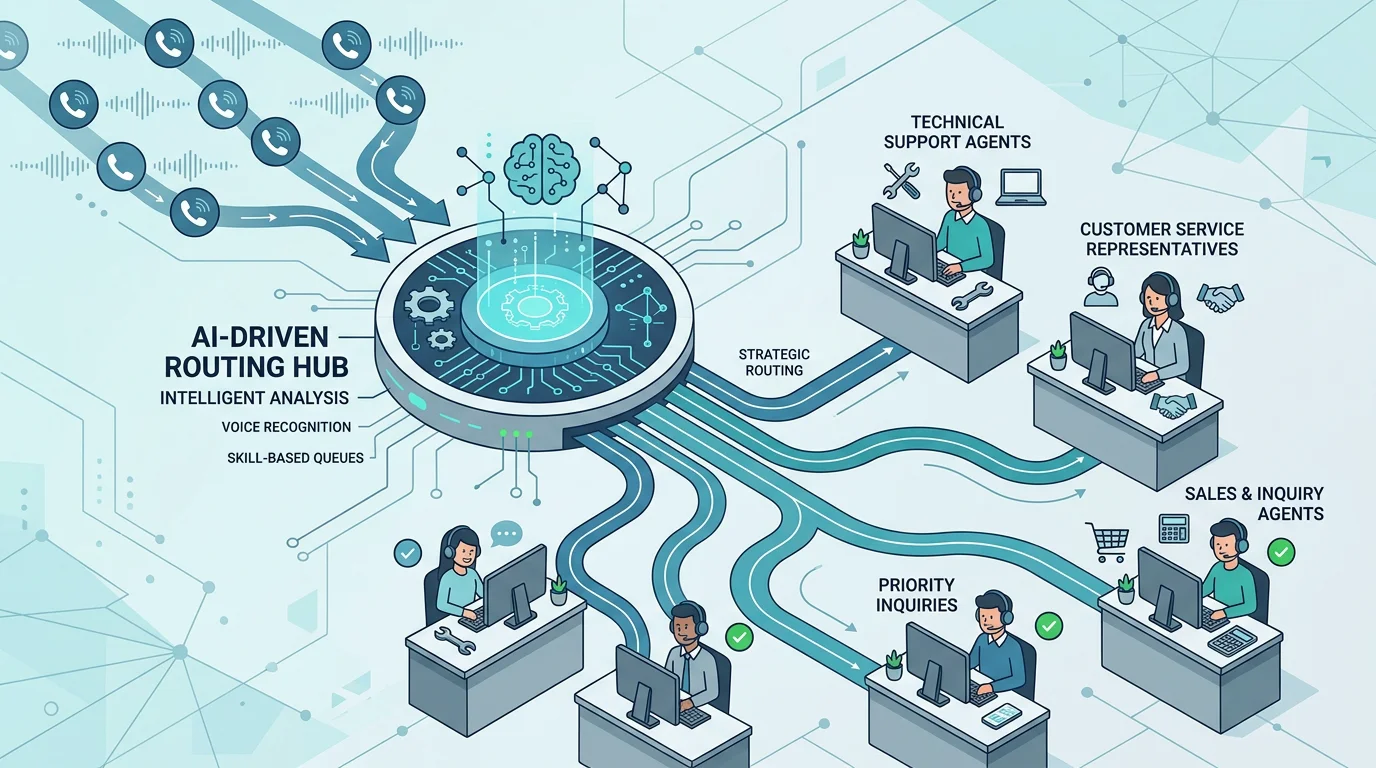
At its simplest, the call distribution process can be reduced to three sequential stages. Understanding them clarifies how the entire system behaves under pressure.
- Caller identification. The system captures the caller’s purpose through IVR, and uses caller ID or automatic number identification to detect language, location, and account history.
- Call queueing. When every agent is busy, callers are sorted into a waiting list. The queue order reflects factors such as wait time, query type, agent availability, and VIP status.
- Call routing. Finally, the system connects the caller to an agent based on your chosen distribution rules, whether that means the fastest available person or the most qualified specialist.
Behind these stages, the software continuously monitors agent status, tracks call duration, and analyzes historical patterns. That data layer is what allows a platform to predict demand and optimize scheduling rather than simply pass calls along.

Common Call Distribution Methods
The right platform gives you several ways to build a routing strategy that fits your team. Each method balances speed, fairness, and expertise differently.
- Fixed order: calls always go to your highest-ranked available agent first, then cascade downward.
- Round robin: calls rotate evenly through the team so workloads stay balanced.
- Idle time based: the call goes to whoever has been free the longest, maximizing productivity.
- Availability based: ideal for remote or distributed teams, routing by schedule and time zone.
- Skills-based routing: the system matches caller needs to agent expertise, sending a billing query to a billing specialist or a Spanish speaker to a bilingual agent.
- Simultaneous: every available phone rings at once, prioritizing speed to answer.
- Weighted: each agent handles a defined percentage of total calls, useful when onboarding new staff.
Among these, skills-based routing tends to deliver the strongest results for larger operations, because connecting callers to the right expertise raises first-contact resolution.
Why ACD Matters for Customer Experience
The cost of getting this wrong is enormous. CMSWire reports that U.S. companies still lose an estimated $75 billion annually due to poor customer service. Much of that loss begins with calls that are mishandled, delayed, or routed to the wrong person.
A well-configured automatic call distributor addresses these failures directly. It distributes work fairly across your team, reduces agent idle time, and ensures customers reach a capable person quickly. The benefits compound:
- Shorter wait times and lower call abandonment.
- Higher first-call resolution through expertise matching.
- Better workforce management with evenly shared workloads.
- Easier coaching through real-time call monitoring.
- Richer analytics on hold time, talk time, and resolution rates.
Cloud delivery amplifies every one of these advantages. With our cloud-based contact center software, you can adjust routing rules and add agents in a few clicks, scaling up or down as demand shifts without touching any hardware.
AI Is Rewriting Call Routing
The most significant change in this category is the move from static menus to AI-driven routing. Instead of forcing callers through rigid keypad trees, conversational AI interprets intent in natural language and routes on the first ring. The efficiency gains are measurable.
Industry data compiled by Digital Minds BPO indicates that around 60% of customer service agents say that AI helps them save time in routing calls and processing inquiries. The same research notes that annual call center turnover runs at 40 to 45% in 2025, which makes any tool that reduces repetitive routing work genuinely valuable for retention.
This is where a layer of automation pays off. Our AI Voice Agent answers calls around the clock, schedules appointments, and resolves common questions before a human is ever needed. The result is fewer queued calls, less burnout, and human agents reserved for complex, high-stakes conversations.
Choosing the Right Call Distribution System
Selecting a platform is less about feature counts and more about fit. Consider your current call volumes, your growth plans, the routing methods you genuinely need, ease of integration with existing tools, reliability, security, and the quality of vendor support.
The table below contrasts three approaches so you can see where value concentrates.
| Capability | Legacy PBX | Basic ACD add-on | Our cloud contact center |
|---|---|---|---|
| Skills-based routing | Limited | Partial | Yes |
| 24/7 AI voice coverage | No | No | Yes |
| Hardware required | Extensive | Some | $0 |
| Deployment time | Weeks to months | Weeks | Days |
| Real-time analytics | Minimal | Basic | Full dashboards |
| Uptime guarantee | Varies | Varies | 99.9% |
| Starting price | High capital cost | Varies | $16.99/user/month |
When you weigh long-term value rather than sticker price, an integrated cloud platform consistently comes out ahead. To compare options across features and support, you may also review our call center software in detail.
Conclusion
Call routing is no longer a back-office detail; it is a frontline driver of trust. With automatic call distribution software, you connect callers to the right agent faster, balance your team’s workload, and capture the analytics needed to improve continuously. Given that poor service costs US companies an estimated $75 billion every year, the return on getting distribution right is difficult to overstate. The technology has matured, AI has removed much of the friction, and cloud delivery has made adoption fast and affordable. Built for businesses of every size, our integrated communications suite combines distribution, AI voice coverage, and real-time reporting from a single provider with no hardware to manage. To see how it performs against your current setup, explore our products for call distribution and call center automation.
Frequently Asked Questions
What is the difference between ACD and IVR?
IVR is the automated menu that greets callers and collects information about their needs. ACD then uses that information to route the call to the most suitable agent. They work together, but only the ACD performs distribution.
Does automatic call distribution require special hardware?
No. Modern cloud-based systems run entirely as software. Our cloud contact center software, for example, requires no hardware and can be deployed in days rather than weeks.
Which routing method is best for my team?
It depends on your priorities. Skills-based routing suits larger teams seeking higher first-call resolution, while round robin or idle-time routing favors balanced workloads across smaller groups.