Summary: An AI receptionist answers business calls around the clock, reducing front-desk costs by up to 62% while increasing booked appointments by 27%.
Every missed phone call is a missed opportunity. According to recent industry research, businesses lose an average of $450 per unanswered call, adding up to roughly $42,000 in preventable revenue loss each year. In a market where customers expect instant responses, letting calls roll to voicemail is no longer a viable strategy. The rise of the AI receptionist offers US businesses a smarter path forward, one that combines 24/7 availability with intelligent call handling, and our AI receptionist solutions are designed to deliver exactly that.
Whether you operate a healthcare practice, a law firm, a dental office, or a growing sales team, an AI-powered virtual receptionist can transform how your organization manages inbound communications. This technology does not simply route calls; it holds natural conversations, schedules appointments, captures leads, and resolves common inquiries without human intervention. As adoption accelerates across the United States, understanding what this technology can do for your bottom line is essential.
What Is an AI Receptionist and How Does It Work?
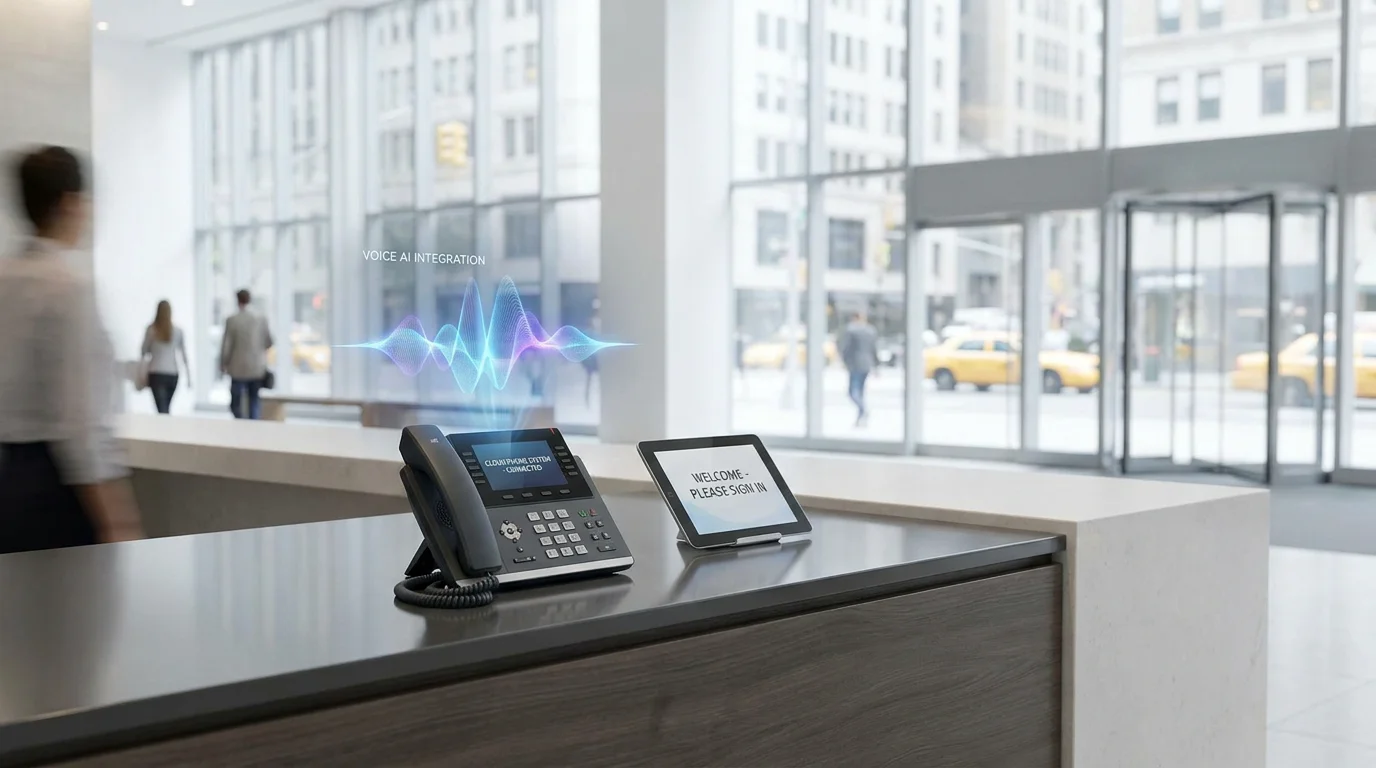
An AI-powered receptionist is a software application, typically integrated with a cloud business phone system, that uses natural language processing to answer calls, understand caller intent, and take appropriate action. Unlike legacy interactive voice response (IVR) systems that force callers through rigid menus, a modern virtual receptionist engages in genuine, human-like dialogue.
When a call comes in, the AI greets the caller, identifies the reason for their inquiry, and determines the best response. It can answer frequently asked questions, book or reschedule appointments by syncing with your calendar, capture lead details for your CRM, and transfer complex calls to the appropriate team member along with a full conversation summary. As of 2026, the median end-to-end response latency for production voice AI systems is 680 milliseconds, down from 1,200 milliseconds in 2024, making these interactions feel remarkably natural.
This capability extends far beyond a simple answering service. Caller intent detection accuracy across all industries reaches 87%, rising to 94% in domains with well-trained knowledge bases. The result is a front-desk experience that handles routine inquiries instantly while ensuring high-priority callers reach a live person without delay.
The Real Cost of Missed Calls for US Businesses
For small and mid-sized businesses across the United States, unanswered calls represent one of the largest hidden sources of revenue loss. Businesses lose an average of $450 per missed call, amounting to $42,000 annually in preventable losses, and Zendesk data reveals that 93% of callers never call back after reaching voicemail.
The problem is especially acute for service-oriented firms. In home services, 62% of inbound calls go unanswered, while in professional services the miss rate is 54%. According to a 2026 industry analysis, callers who do not get through rarely wait; the vast majority move on to a competitor.
A traditional receptionist works roughly 40 hours per week, leaving 128 hours uncovered. During those off-hours, evenings, weekends, and holidays, potential clients are calling and finding no one to answer. An automated call handling solution eliminates this gap entirely by remaining available every hour of every day.
Key Benefits That Drive Adoption
Why are businesses across healthcare, legal, dental, real estate, and financial services turning to AI-driven reception at such a rapid pace? The advantages are both operational and financial.
- 24/7 availability: Every call is answered, whether it arrives at 2 PM on a Tuesday or 2 AM on a Sunday. No voicemail, no busy signals, no lost opportunities.
- Cost savings: AI receptionists save businesses an average of 62% compared to full-time human receptionists, which translates to tens of thousands of dollars annually.
- Increased appointments: Businesses using AI receptionists report a 27% increase in booked appointments thanks to instant scheduling and follow-up capabilities.
- Scalability: Whether five calls arrive simultaneously during a peak hour or a single inquiry comes in at midnight, the AI handles each one with consistent quality.
- Multilingual support: Modern systems recognize and switch languages mid-conversation, serving diverse caller populations seamlessly.
- Intelligent routing: When a call requires human attention, the AI transfers it to the right team member along with context and a summary, so the caller never has to repeat themselves.
For organizations seeking to evaluate their options and compare tiers, our AI receptionist pricing plans provide a transparent starting point.
Market Growth and Adoption in 2026
The numbers behind AI reception adoption tell a compelling story. The global virtual receptionist service market stands at USD 4.64 billion in 2026 and is expected to reach USD 10.85 billion by 2035, growing at a CAGR of 9.8%. According to Business Research Insights, North America leads the way with a 41% market share.
The U.S. Small Business Administration reports that over 60% of small businesses in the United States have started adopting AI-powered tools to automate customer interaction, including virtual receptionist services. This is not limited to tech-savvy coastal firms. AI receptionist adoption is not concentrated in tech hubs or coastal cities; it is nationwide, from rural markets to major metros.
The broader voice AI segment is growing even faster. The global voice AI market was valued at approximately $9.4 billion in 2025 and is growing at a 28.5% CAGR, signaling that conversational AI for phone systems will become standard business infrastructure within the next few years.
Industry-Specific Applications
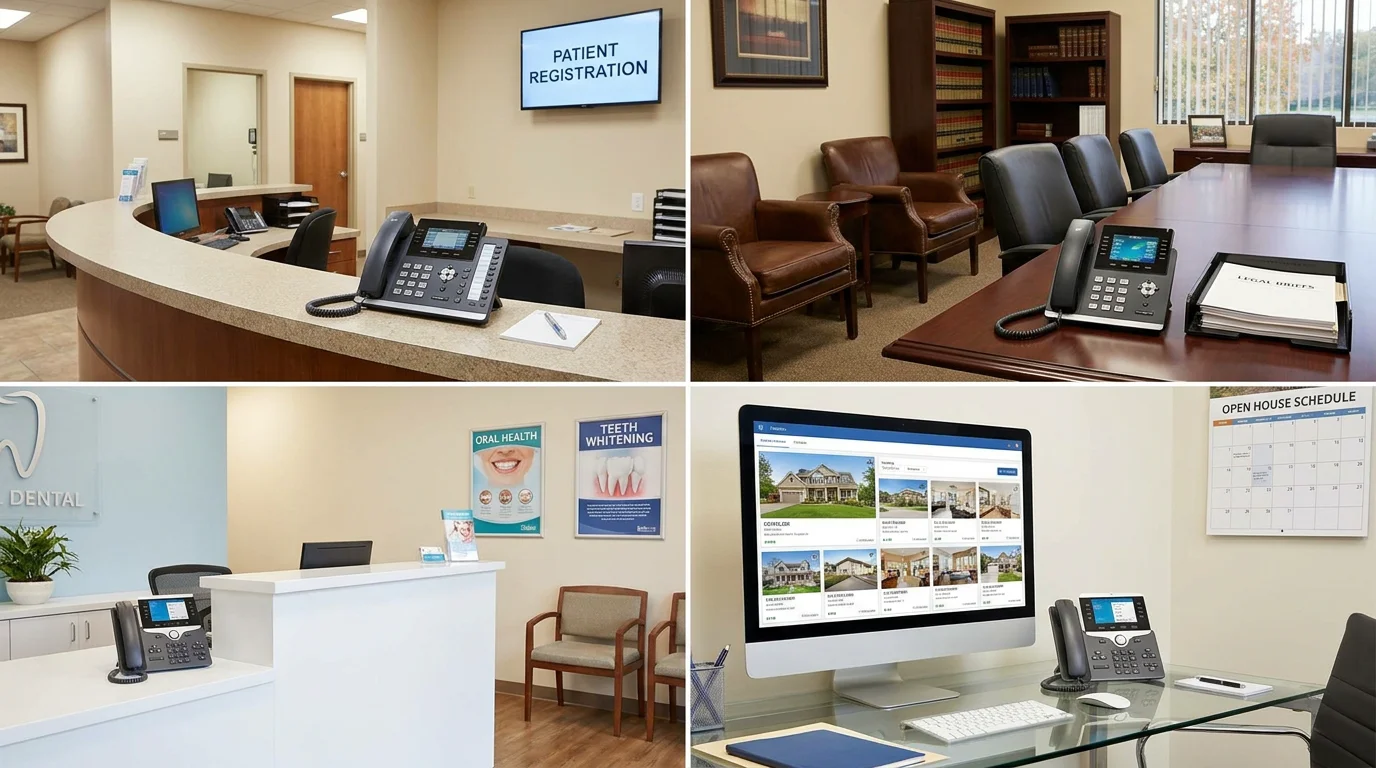
Healthcare, legal, and home services account for 72% of current AI receptionist deployments, according to SchedulingKit’s 2026 data compilation. Each vertical benefits in distinct ways.
Healthcare and Dental Practices
Beyond the 38% of healthcare practices already using AI, an additional 41% plan to implement AI phone handling within the next 18 months, driven by staff shortages (cited by 62% of respondents) and patient demand for 24/7 booking access (cited by 54%). For dental offices, the gains are equally tangible: dental practices using AI receptionists report 31% fewer unfilled appointment slots, because the AI captures cancellations instantly and offers the time to waitlisted patients within seconds.
Legal and Professional Services
Law firms calculate 1,775% ROI from AI receptionist implementation; five-person firms save $45,000 annually in labor costs, and after subtracting $2,400 in AI costs, net savings reach $42,600 yearly. Beyond cost reduction, consistent and immediate client communication reduces malpractice risk and improves intake quality.
Real Estate, Financial Services, and Sales Teams
For real estate agencies, an AI-powered receptionist captures buyer leads and shares property details instantly, even when agents are showing homes. Financial services and sales organizations benefit from automated lead qualification, ensuring that high-intent prospects are routed to advisors without delay. Response time reductions from 24 to 48 hours down to 30 seconds yield measurable conversion gains; one case study showed lead-to-appointment conversion improving from 49% to 70%.
Our platform is purpose-built for these verticals. By combining hosted VoIP, an intelligent voice AI agent, and cloud contact center software, we deliver a unified communication stack that eliminates fragmented tools and covers every call, from initial inquiry through resolution.
How to Evaluate an AI Receptionist Solution
Not every AI receptionist platform is created equal. When comparing options, consider these critical factors:
| Criterion | What to Look For | Cloud Vision Technologies |
|---|---|---|
| Availability | True 24/7 coverage with no downtime | 24/7 AI voice coverage with 99.9% uptime guarantee |
| Setup Complexity | Fast deployment, no hardware | Deployment in days; $0 hardware required |
| Integration | CRM, calendar, and phone system compatibility | Three integrated products from one provider (VoIP, AI agent, contact center) |
| Security | Enterprise-grade encryption and compliance | Bank-grade encryption with enterprise security standards |
| Pricing | Transparent, scalable tiers | Starting at $16.99 per user per month |
| Support | Dedicated assistance for setup and optimization | Dedicated support team included |
Accuracy is no longer the bottleneck; implementation quality is. A poorly configured AI voice agent with a thin knowledge base will perform at 70 to 80% resolution, while the same underlying technology, properly configured, hits 92 to 96%. That is why choosing a provider that offers robust onboarding and ongoing optimization matters as much as the technology itself.
ROI and Financial Impact You Can Expect
The financial case for an AI-powered virtual receptionist is difficult to dispute. A small service business with 5 to 50 employees typically saves $23,000 to $42,000 annually by replacing a full-time receptionist with AI; contact centers report 60 to 80% reduction in per-call costs; the median ROI breakeven is 3.2 months; and beyond direct cost savings, businesses report an average 18% revenue increase from eliminated missed calls and faster lead response.
Consider the math from a different angle. At 500 calls per month, AI plans cost approximately $0.10 per call compared to $1.38 to $1.60 for human or hybrid services, representing a 15x cost advantage according to a Q1 2026 industry report.
The return is not limited to cost savings alone. AI-first call handling with human escalation achieves 92% customer satisfaction, the highest of any model tested. Your callers receive faster, more consistent service, while your team is freed to focus on complex, high-value interactions.
Customer Experience: What Callers Actually Think
A common concern is whether callers will tolerate interacting with AI. The evidence suggests the experience is not just tolerable; it is often preferred for routine tasks. In 2026, 62% of consumers say they are comfortable interacting with an AI voice agent for routine tasks such as scheduling and information requests, up from 41% in 2024.
Additionally, 28% of consumers actively prefer AI over human agents for simple tasks, citing speed and no hold time as the primary reasons. And in blind testing, 71% of callers could not reliably distinguish between an AI receptionist and a human in tests using 2026-generation voice synthesis.
The key is configuration quality. A well-designed system that is trained on your specific services, policies, and processes delivers consistent, on-brand conversations that leave callers satisfied. To explore more on AI receptionists and best practices for deployment, our resource library offers in-depth guidance.
Getting Started: From Evaluation to Go-Live
Deploying an AI receptionist does not require a technical team or a lengthy implementation cycle. The typical path looks like this:
- Define your goals: Identify the primary problem you want to solve. Is it after-hours coverage, appointment scheduling, lead capture, or reducing call abandonment?
- Assess your call flow: Map out how calls currently move through your organization, including peak times, common inquiries, and escalation paths.
- Choose your provider: Evaluate platforms based on availability, integration capabilities, security, and pricing transparency.
- Configure and train the AI: Upload your FAQs, business hours, services, and routing rules. The best platforms let you go live in minutes, not months.
- Monitor and optimize: Use analytics dashboards to track call volumes, resolution rates, and customer satisfaction. Refine the knowledge base over time.
With no hardware required and deployment timelines measured in days, the barrier to entry has never been lower. Businesses that move quickly gain an operational advantage; those that adopt now are building capability and customer familiarity ahead of the wave.
In a market where every unanswered call can mean a lost client, an AI-powered receptionist is no longer a luxury. It is a strategic necessity. The data is unambiguous: businesses that adopt this technology reduce costs, capture more revenue, and deliver a better caller experience. With 24/7 AI voice coverage, enterprise-grade security, and a unified platform that integrates VoIP, intelligent voice agents, and contact center software, we are built to help you answer every call and convert every opportunity. To see the difference for yourself, book a free demo of our AI Voice Agent and discover what seamless call handling looks like.
Frequently Asked Questions
Will an AI receptionist replace my existing staff?
No. An AI receptionist is designed to augment your team, not replace it. It handles the routine 70% of calls (scheduling, FAQs, basic inquiries) so your staff can focus on complex, high-value interactions that require human judgment. Most businesses keep and even grow their teams after implementation.
How long does it take to set up an AI receptionist?
Most modern platforms, including our Intelligent Voice AI Agent, allow you to go live within days. There is no hardware to install. You configure the system with your business information, connect it to your phone line, and begin accepting calls.
Is an AI receptionist suitable for regulated industries like healthcare or legal?
Yes. Leading AI receptionist platforms offer compliance-ready infrastructure, including encryption, audit logs, and adherence to regulations such as HIPAA. In fact, healthcare, legal, and home services represent the majority of current deployments nationwide.