If your team is still manually logging call notes after every customer conversation, you’re losing time, money, and deals. VoIP CRM integration for small business connects your cloud phone system directly to your customer relationship management software — so every call, voicemail, and contact detail syncs automatically. For SMBs competing in 2026, this combination isn’t a luxury; it’s a core productivity tool that separates growing teams from stagnant ones.
At Cloud Vision, we’ve built our hosted VoIP platform to work seamlessly alongside the CRM tools small businesses already rely on. Here’s everything you need to know about making VoIP and CRM work together — and why it matters more than ever.
What Is VoIP CRM Integration?
VoIP CRM integration is the process of connecting your cloud-based business phone system with your CRM platform so that data flows automatically between them. When a customer calls in, your CRM screen-pops their full profile. When your rep hangs up, the call duration, recording, and notes are logged without manual entry. When a prospect is ready to buy, your sales team can click-to-dial from inside the CRM — no tab-switching, no misdialed numbers.
In simple terms: your phone and your customer database become one intelligent system.
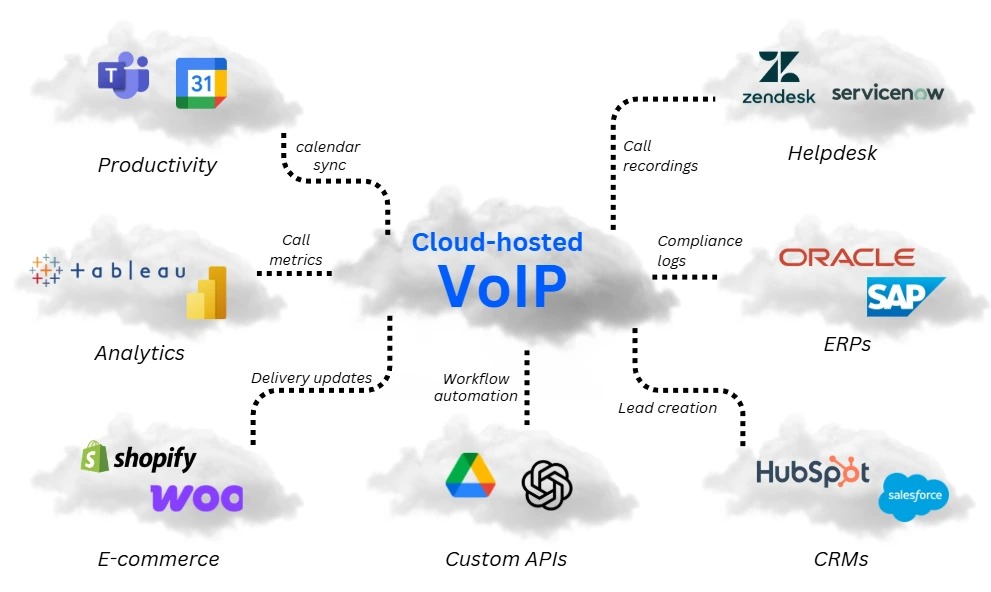
Why SMBs Need VoIP CRM Integration in 2026
Small and medium-sized businesses operate with lean teams and tight margins. Every minute spent on manual data entry is a minute your team isn’t selling, serving, or growing. Here’s why VoIP CRM integration is a game-changer for SMBs specifically:
- Eliminate double entry: Call logs, contact updates, and follow-up tasks sync automatically — no more post-call admin work.
- Faster response times: Screen pops give your team a complete customer view the moment a call connects, so every interaction feels personal and informed.
- Accurate pipeline data: Every call activity is captured in the CRM, giving managers real visibility into sales performance without micromanaging.
- Better customer experience: Customers don’t have to repeat themselves. Your team already knows who they are and what they need.
- Smarter coaching: Integrated call recordings inside the CRM make it easy to review conversations, identify coaching opportunities, and replicate what your top performers do differently.
According to Salesforce research, high-performing sales teams are 2.8x more likely to use integrated tools than their lower-performing counterparts. Closing the integration gap starts with your phone system.
Key Features to Look For in a VoIP CRM System
Not all VoIP systems integrate equally. When evaluating a cloud VoIP phone system for your small business, look for these integration must-haves:
- Screen pop / CRM caller lookup: Automatically pulls up the caller’s full record the moment they call in.
- Click-to-dial: Let reps call directly from any CRM contact, lead, or deal — one click, no manual dialing.
- Automatic call logging: Duration, direction (inbound/outbound), outcome, and notes posted to the CRM record without manual effort.
- Call recording sync: Recordings stored inside the CRM activity timeline, accessible to managers for review and coaching.
- Voicemail drop: Leave a pre-recorded message with one click and move to the next dial — a massive time-saver for outbound prospecting.
- Real-time analytics: See call volume, wait times, and rep performance alongside your CRM pipeline metrics in a single view.
- Mobile app support: Integration should work from your smartphone, not just the desktop — critical for field-based SMB teams.
Popular CRM Platforms That Connect With Cloud VoIP
The most widely used CRM platforms for small businesses all support cloud VoIP integration through native connectors or open APIs:
- HubSpot CRM — One of the most SMB-friendly CRMs, HubSpot supports third-party VoIP integrations through its App Marketplace and offers robust native calling features.
- Salesforce — The enterprise standard with deep VoIP CTI (Computer Telephony Integration) support and powerful automation capabilities.
- Zoho CRM — A cost-effective choice for SMBs with built-in telephony options and flexible third-party VoIP connectivity.
- Pipedrive — A pipeline-focused CRM popular with small sales teams, offering VoIP integration through its App Marketplace.
- Freshsales — Bundles CRM and calling in one platform with built-in VoIP, ideal for growing SMBs looking to consolidate tools.
Cloud Vision’s hosted VoIP connects to your existing CRM via standard integrations — you’re never forced to rip and replace your tech stack. Contact our team to confirm compatibility with the CRM your business already uses.
How to Set Up VoIP CRM Integration: A Step-by-Step Guide
Setting up VoIP CRM integration is simpler than most SMBs expect. Here’s a realistic overview of what the process looks like:
- Choose a cloud VoIP provider with native CRM connectors. Not all VoIP providers offer pre-built integrations. Confirm your provider supports your CRM before you sign anything.
- Authenticate the integration. Most integrations connect via OAuth — you log into your CRM from inside the VoIP dashboard and grant permission. This typically takes under five minutes.
- Configure call logging rules. Decide which activities to auto-log (all calls, outbound only, calls over a certain duration) and where they post in the CRM (contact record, deal, or activity timeline).
- Enable screen pop for inbound calls. Map your CRM contact fields to the VoIP caller ID lookup so your team sees the right record automatically on every call.
- Train your team on click-to-dial and voicemail drop. These two features alone can save a sales rep 60–90 minutes per day on outbound prospecting.
- Review analytics after 30 days. Use the integrated reporting to identify peak call times, common outcomes, and rep-level performance patterns worth acting on.
With Cloud Vision, our onboarding team handles the technical setup for you — including CRM integration configuration. You’ll be live in days, not weeks, with no hardware to install and no IT department required. Ready to get started? Call 844-921-3412 or reach out online.
VoIP CRM Integration vs. Standalone Phone Systems
Businesses relying on a basic phone line or legacy PBX lose data at every customer touchpoint. Here’s how integrated cloud VoIP compares:
| Feature | Traditional Phone System | Cloud VoIP + CRM Integration |
|---|---|---|
| Call logging | Manual, error-prone | Automatic, real-time |
| Caller context | None | Full CRM screen pop |
| Recording access | Separate system (if any) | Linked inside CRM record |
| Reporting | Limited or none | Call + pipeline analytics |
| Remote access | Office-only | Anywhere, any device |
| Setup time | Days to weeks + hardware | Hours to days, no hardware |
Want to see what a modern setup looks like for your team? Explore our hosted VoIP pricing guide to understand costs and what’s included.
Frequently Asked Questions About VoIP CRM Integration
Does VoIP CRM integration work for very small businesses with only a few employees?
Absolutely. VoIP CRM integration scales down just as well as it scales up. Even a two-person sales team benefits from automatic call logging and screen pops — it eliminates the administrative burden that slows small teams down disproportionately. Cloud Vision’s hosted VoIP plans start with single-user options and grow with your headcount.
Will I need an IT team to set up VoIP CRM integration?
No. Modern cloud VoIP CRM integrations are built for non-technical users. Most connections are OAuth-based and take minutes to configure from a browser. Cloud Vision’s onboarding team handles setup end-to-end — including CRM integration — so you’re never left figuring it out alone.
Which CRMs are compatible with Cloud Vision’s VoIP system?
Cloud Vision’s hosted VoIP integrates with the major CRM platforms SMBs rely on, including HubSpot, Salesforce, Zoho, and Pipedrive. If you’re using a less common CRM, our team can assess API compatibility. Contact us to confirm your CRM before you start.
Does VoIP CRM integration include call recording?
Yes. Cloud Vision’s platform includes call recording as a standard feature. When CRM integration is active, recordings are automatically linked to the corresponding contact or deal record inside your CRM — making review, compliance, and team coaching significantly easier.
How much does VoIP CRM integration cost for a small business?
CRM integration is typically included in cloud VoIP plans rather than billed separately. Cloud Vision offers transparent, per-user monthly pricing with no hidden fees — and integration setup is included in onboarding at no extra cost. Request a custom quote to see exact costs for your team size.
Ready to Connect Your Phone System and CRM?
The most productive SMB teams in 2026 aren’t working harder — they’re working smarter, with systems that share data automatically and eliminate repetitive tasks. VoIP CRM integration is one of the highest-ROI upgrades a small business can make: lower admin overhead, faster sales cycles, and a far better experience for every customer who calls.
Cloud Vision’s hosted VoIP is purpose-built for small and medium businesses — with the integrations, enterprise features, and hands-on support to make the switch easy. We go live in days, not months, with no hardware required and 99.9% uptime guaranteed.
See VoIP CRM integration in action for your business:
Or call us directly at 844-921-3412 — our team is ready to walk you through a live demo tailored to your business and build a custom quote on the spot.